Sunday, 8 January 2023

'The Birches' by Robert Frost

 Hello Everyone, I'm a student of The Department of English,M.K.B.U. This blog is assigned by Megha Madam as a thinking activity. This blog is based on Robert Frost's one famous poem 'The Birches '(1915).


The Birches

-By Robert Frost 


Points to Ponder 

  • Introduction

  • About Poet

  • Pptx and Video based on Robert Frost 

  • About Poem

  • Analysis of the poem

  • Style of Writing 

  • Figures of Speech

  • Thematic analysis of the poem

  • Symbols in 'Birches' 

  • Conclusion


Introduction :- 


This poem is written by An American Poet, Robert Frost. This is one of his famous poems. In this poem he tries to describe the condition of a tree,Birches. We can connect it with our day to day life and how we are facing different situations or problems , though it could harm us but we will succeed if we face those problems. He also recalls his childhood memories and he expresses his feelings through this poem. 


About Poet :-


Robert Lee Frost (March 26, 1874 – January 29, 1963) was an American poet. His work was initially published in England before it was published in the United States. Known for his realistic depictions of rural life and his command of American colloquial speech,Frost frequently wrote about settings from rural life in New England in the early 20th century, using them to examine complex social and philosophical themes.


Frequently honoured during his lifetime, Frost is the only poet to receive four Pulitzer Prizes for Poetry. He became one of America's rare "public literary figures, almost an artistic institution". He was awarded the Congressional Gold Medal in 1960 for his poetic works. On July 22, 1961, Frost was named poet laureate of Vermont.


Pptx and Video based on Robert Frost:-


About Poem :-


For Original Poem  Click Here


'Birches' is a poem by American poet Robert Frost. First published in the August, 1915 issue of The Atlantic Monthly together with "The Road Not Taken" and "The Sound of Trees" as "A Group of Poems". It was included in Frost's third collection of poetry Mountain Interval, which was published in 1916. Consisting of 59 lines, it is one of Robert Frost's most anthologized poems. Along with other poems that deal with rural landscape and wildlife, it shows Frost as a nature poet.


Analysis of the poem :-


In this poem the poet sees the Birches trees and recalls his past and also tries to find the reasons behind the bowing of those trees . He imagines two different reasons behind that and he also recalls his childhood, how he also played with these trees. 


There is three different Images or scenes in this poem that are like.,

  • Ice-storms

  • Swinging of a boy

  • His (poet's) childhood


  • Ice-storms


In the first some of the line poet describes that because of the Ice-storms this trees are bowing and he also describes the beauty of that trees how they are bowing through the flow of ice-storms and he also describes when sun is rising at that time ice  melting during that time the Rays of the sun is convert in to a beautiful colours like a rainbow. He also says that ice-storms can bow them but they cannot harm or kill the trees.


  • Swinging of a boy :-


In the next scene ,the poet describes that this tree may have the father of that  boy who is swinging on this tree and bowing it but on the other hand he also describes that a boy cannot bow to it. He is enjoying playing with it and he might only know this game to play with the trees. 


  • His (poet's) childhood :-


In the third scene ,the poet describes his desires and feelings or he also discuss on his childhood that he used to swinging on this trees and he enjoys a lot in this game and now he is wanting to swing on this trees for some time and he wants to escape from the day-to-day's life and enjoy the swinging on the trees and enjoy the nature. He also compares the beauty of the Birches with so many things.


  • Style of Writing


This poem is written in a blank verse, with numerous variations on the prevailing iambic foot. It consists of 59 lines.


Birches’ is written in blank verse: unrhymed iambic pentameter. This means that there are (usually) ten syllables per line, with the syllables arranged into five metrical feet, in this case iambs, which comprise an unstressed syllable followed by a stressed one. Frost was fond of using blank verse in his poetry: since it is close to the rhythms of regular human speech in the English language, it reflects his homespun, colloquial style. In the case of ‘Birches’, the unrhymed iambic pentameter rhythm suits the poem’s meditative, reflective mode.


  • Figures of Speech


  1. Simile :-

A comparison of two things with the use of the words like., " Like","as".

  • "Trailing their leaves on the ground

Like girls on hands and knees that throw their hair"

  • "And life is too much like a pathless wood"


  1. Metaphor :-

A figure of speech in which a word or phrase is applied to an object or action to which it is not literally applicable. Or a comparison of two things without using the words  "like", "as".

  • "Soon the sun’s warmth makes them shed crystal shells

Shattering and avalanching on the snow-crust—

Such heaps of broken glass to sweep away

You'd think the inner dome of heaven had fallen."

  • "Toward heaven, till the tree could bear no more, ..." 

  • "May no fate willfully misunderstand me  And half grant what I wish and snatch me away  Not to return...." 

  • "One eye is weeping..." 

  • "like a pathless wood  Where your face burns and tickles with the cobwebs  Broken across it,..." 

  • "You'd think the inner dome of heaven had fallen. ..." 


  1. Imagery :-

Visually descriptive or figurative language, especially in a literary work.


  • "I'd like to get away from earth awhile  And then come back to it..." 

  • "One eye is weeping..."

  • "Soon the sun's warmth makes them shed crystal shells  Shattering and avalanching on the snow-crust—..." 

  • "As the stir cracks and crazes their enamel. ..."

  • "They click upon themselves  As the breeze rises,..."


3. Personification :- 

The attribution of a personal nature or human characteristics to something non-human, or the representation of an abstract quality in human form.


  • "Though once they are bowed  So low for long, they never right themselves:..." 


Thematic analysis of the poem :-


  1. The Conflict Between Fantasy and Reality :- 


In the speaker’s stream of consciousness, two voices diverge and chatter along in a parallel tension. The first voice is that of fantasy; it longs for the woodland birches to stand as symbols of personal meaning. It assumes the birch trees were bent by a boy at play, a boy much like the speaker once was, glimpsing heaven in the exhilarating heights of the birches. The second voice is that of reality; it understands the “Truth” that the birches were bent by a storm and that any illusions otherwise are an indulgence. This voice’s “Truth” reaches much farther, however, for it knows that the glimpse of heaven high in the birches is merely a glimpse; one cannot escape the earth.


  1. The Power of Memory :-


The speaker’s memories of childhood create a deeper layer of events and meanings in the narrative of the poem. Confronting the arching birches, the speaker is immediately reminded of his own childhood days spent swinging upon and bending birch trees. Because those childhood memories are so laced with bliss, the speaker, now laden with the responsibilities and difficulties of adult life, sees in his past the image of heaven. Looking at the birch trees afresh, he wonders whether such heaven remains available to him.


  1. The Longing for Heaven and the Pull of Earth:-


The central thematic duality of the poem is that of heaven and earth. It is a tension which arises from the speaker’s boyhood memories of birch swinging, moments which were heavenly in their ascendent lightness and carefreeness. It is such a state of Edenic innocence the speaker longs for now as he strides the woods as an adult, freighted with the cares and sorrows of maturity. Gravity is the proper metaphorical force here, for the speaker feels weighed down toward the earth. The speaker strives to locate a resolution between his desire for heaven and his fate on earth.


Symbols in 'Birches' :-

The use of symbols is quite important when determining the figurative meaning of the 'Birches' poem.


  1. Swinging on Birch Trees


The action of swinging on birch trees represents the speaker's escape from reality. His life has become tiresome, and he imagines swinging on the birch trees and climbing 'toward heaven' in order to escape from his current adult reality.


Conclusion :-

To sum up ,we can say that ,through this poem the poet tries to describe his personal feelings as well as the condition of the three 'The Birches' and how they are facing the problems and damages through the different incidents. The same situations we also find in our life when something is happening or the right time passes out we cannot bring them back like bowing trees. They can survive in their life but they cannot remove their damages.


Word Count :- 1522

Pptx :- 01

Videos :- 02

Images :- 06


Tuesday, 3 January 2023

Trends and Movements


Hello everyone, I'm a Student of The Department of English,M.K.B.U. This blog is based on the 20th Century's three movements like,Surrealism,Expressionism And Dadaism.


Thinking Activity based on 'Surrealism','Expressionism' and 'Dadaism' :-


The Early 20th Century was marked by rapid industrial, economic, social, and cultural change, which influenced the worldview of many and set the stage for new artistic movements.


Points to Ponder :-

  • Introduction

  • About 20th Century

  • Characteristics of the 20th Century

  • Movements of the 20th Century

  • Surrealism, Expressionism and Dadaism in detail

  • Conclusion


Introduction :-

The 20th (twentieth) century began on January 1, 1901 (MCMI), and ended on December 31, 2000 (MM). The 20th century was dominated by significant events that defined the modern era: Spanish flu pandemic, World War I and World War II, nuclear weapons, nuclear power and space exploration, nationalism and decolonization, the Cold War and post-Cold War conflicts, and technological advances. These reshaped the political and social structure of the globe.


The century saw a major shift in the way that many people lived, with changes in politics, ideology, economics, society, culture, science, technology, and medicine. The 20th century may have seen more technological and scientific progress than all the other centuries combined since the dawn of civilization. Terms like nationalism, globalism, environmentalism, ideology, world war, genocide, and nuclear war entered common usage.


Characteristics of the 20th Century :-

  1. Modernist writers were influenced by such thinkers as Sigmund Freud and Karl Marx, amongst others, who raised questions about the rationality of the human mind.

  2. Marked by a strong and intentional break with tradition. This break includes a strong reaction against established religious, political, and social views.

  3. A central preoccupation of Modernism is with the inner self and consciousness.

  4. The Modernist cares little for Nature, Being, or the overarching structures of history.

  5. The “unreliable” narrator supplanted the omniscient, trustworthy narrator of preceding centuries, and readers were forced to question even the most basic assumptions about how the novel should operate.

  6. There is no such thing as absolute truth. All things are relative.


Artistic Movements of this time :- 

The 20th century saw a new era of visual artists who challenged the precedent art styles. Beauty and aesthetics gave way to abstraction, expression and symbolism. This metamorphosis formed numerous distinct and important art movements which presented a new type of aesthetic, some which overlap with or influenced the others. Below is a broad overview of the most influential visual art movements during the 20th century, excluding some of those shorter-lived or lesser known.


Artistic movements of this time :-


  1. Fauvism (1905-1908)

  2. Expressionism (~1905-1920)

  3. Cubism (1907-1914)

  4. Futurism (1909-1914)

  5. Dadaism (1915-1924)

  6. Surrealism (1924-1966)

  7. Abstract Expressionism (1943-1965)

  8. Pop Art (1950s-70s)

  9. Minimalism (1960s-70s)

  10. Postmodernism (1980s-current)


  1. Fauvism (1905-1908)


Fauvism, a style of painting that flourished in France around the turn of the 20th century. Fauve artists used pure, brilliant colour aggressively applied straight from the paint tubes to create a sense of an explosion on the canvas.


  1.  Expressionism (~1905-1920)


A style of painting, music, or drama in which the artist or writer seeks to express the inner world of emotion rather than external reality.


  1. Cubism (1907-1914)


An early 20th-century style and movement in art, especially painting, in which perspective with a single viewpoint was abandoned and use was made of simple geometric shapes, interlocking planes, and, later, collage.


  1. Futurism (1909-1914)


An artistic movement began in Italy in 1909, which strongly rejected traditional forms and embraced the energy and dynamism of modern technology. Launched by Filippo Marinetti, it had effectively ended by 1918 but was widely influential, particularly in Russia on figures such as Malevich and Mayakovsky.


  1. Dadaism (1915-1924)


A movement in art and literature based on deliberate irrationality and negation of traditional artistic values.


Fountain by Marcel Duchamp, 1917 (replica 1964)


  1. Surrealism (1924-1966)

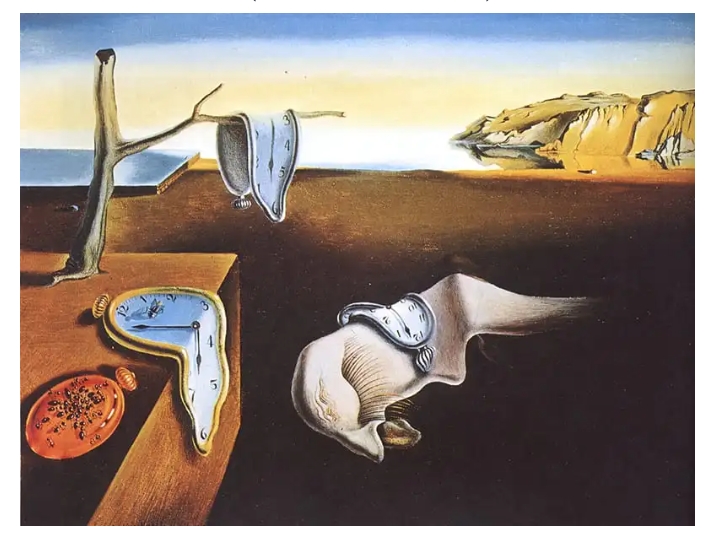
The Persistence of Memory by Salvador Dalí, 1931

Surrealism is a cultural movement that developed in Europe in the aftermath of World War I in which artists depicted unnerving, illogical scenes and developed techniques to allow the unconscious mind to express itself.


  1. Abstract Expressionism (1943-1965)


Abstract expressionism is the term applied to new forms of abstract art developed by American painters such as Jackson Pollock, Mark Rothko and Willem de Kooning in the 1940s and 1950s. It is often characterised by gestural brush-strokes or mark-making, and the impression of spontaneity.


  1. Pop Art (1950s-70s)


Pop art is an art movement that emerged in the 1950s and flourished in the 1960s in America and Britain, drawing inspiration from sources in popular and commercial culture. Different cultures and countries contributed to the movement during the 1960s and 70s.


  1. Minimalism (1960s-70s)


Minimalism focuses on lines, colours, and geometry instead of scenes or accurate depictions of nature. Because of this solid geometric element, it is sometimes called ABC Art.


Postmodernism (1980s-current)


Postmodern art is a body of art movements that sought to contradict some aspects of modernism or some aspects that emerged or developed in its aftermath. In general, movements such as intermedia, installation art, conceptual art and multimedia, particularly involving video are described as postmodern.


Surrealism, Expressionism andin detail :-


  1. Surrealism 


Highly influenced by Sigmund Freud and psychoanalysis, Surrealism sought expression through the exploration of the unconscious mind. Its imagery was characterised by unsettling, dreamlike settings with juxtaposing and often deformed subject matter. Having developed from the avant-garde Dada movement, Surrealism began in Europe and expanded throughout the western world as a cultural, artistic and literary movement.


Known artists: André Breton, Salvador Dalí, Max Ernst, Frida Kahlo, Rene Magritte


Here is my Painting on Surrealism :-


Student's Paintings :-


Justification of my Painting :-


In this painting I try to draw one animal(the deer) but its head is like a human figure. In this painting I mingled both of the figures like the human head and the animal's(the deer) body. It can't be possible in our real life but both of the figures are real. Humans are also there in our life and animals(the deer) are also there in our real life but both cannot be mingled like this. That's why my Painting is Surrealistic.


  1. Expressionism

Expressionism was a modernist movement, beginning with poetry and painting, that originated in Germany at the start of the 20th century. It emphasised subjective experience, manipulating perspective for emotional effect in order to evoke moods or ideas. Expressionist artists sought to express meaning or emotional experience rather than physical reality.


Expressionism was developed as an avant-garde style before the First World War and remained popular during the Weimar Republic, particularly in Berlin. The style extended to a wide range of the arts, including painting, literature, theatre, dance, film, architecture, and music.


It  can be characterised by evocative and emotional pieces that are typically abstract. The use of traditional representation was discarded in favour of communicating the emotion or meaning behind the work. This use of thematic rather than literal expression revolutionised western visual art and became an antecedent for many other 20th-century movements.


Known artists :- Edvard Munch, Egon Schiele, Paul Klee, Wassily Kandinsky,Die Brücke,Der Blaue Reiter.


Here is my Painting on Expressionism :-


Student's Paintings :-


Justification of my Painting :-


In this painting I try to draw a painting of a girl who is going to slip because of the heavy rain. Another interpretation is like this ,that the girl is going somewhere and rain is coming. Or we can say that a girl is enjoying ing the rain. So , my painting is express some expressions that's why we can consider this painting as a expressionistic painting. 


  1. Dadaism


Dada was an international art movement originating in the early 20th century. It created absurd, nihilistic and sometimes incomprehensible art. Dada blurred the lines between visual, performance, and literary arts.

It was led by artists like Hugo Ball, Marcel Duchamp and Sophie Tauber. Its legacy shook the art world quite possibly changed the definition of art itself.


Dada was developed during World War I in Zurich as an avant-garde, anti-art movement. It rejected and mocked the capitalist and nationalistic cultural climate of World War I, focusing instead on the irrational, nonsensical and absurd with strong anti-bourgeois overtones. The movement spread throughout Europe and the United States, echoing far-left radical thought and the overall discontentment with the violence of wartime.


Known artists :- Man Ray, Marcel Duchamp, Hans Arp, Hannah Höch, Tristan Tzara


Here is my Poem on Dadaism  :-


Video based on Dadaism  :-


Justification of my Poetry  :-


This poem is created with the cutting of newspaper. This Poetry is made on 'Dadaism'. There is no meanings in this poetry , even I cannot got the meaning from this poem,though I create this poem. We can just give our interpretations on this poem that's why there is no meanings but another hand it has a numbers of meaning as per our interpretations. So , we can consider this poem as Dadaistic Poem.


Conclusion :-

To sum up, we can say that at the 20th Century Art is only the way of people through which they expresses their emotions and feelings. They were used different Art's to express their inner-voice. Lots of Artistic movements were developed at that time as a result of the World War.


Word Count :- 1515

Images :- 15

Videos :- 01


Thanks for Visiting…….