Saturday, 19 August 2023

Photography Workshop

 Hello Everyone, I'm a student of the Department of English M.K.B.U. This blog is a part of the Sunday reading task which is given by Dr.Dilip Barad sir. In this blog we have to explain our personal view for the photography workshop which is organised by the Department Of English,M.K.B.U.


On 17th August,the Department of English organised a wonderful and very useful Photography workshop. As our Department had made several committees for different works,this workshop has been organised by our 'Art and Creativity Committee Leaders'.


Anchor :- Trushali Dadiya 

Workshop by :- Mr. Kaushik Ghelani

Floral Welcome :- Riya Bhatt

Oral Welcome :- Avani Jani

Feedback by :- Hetal Pathak, Hina Parmar , Dhatri                               Parmar, Bhumiba Gohil


This workshop is decided into two sessions. In the first session Mr. Kaushik Ghelani sir taught us how to click photos and how we should view a photograph and in the second was like a concluding session in which some feedbacks ,gifts were given. Anchoring of this workshop is done by semester three's student Trushali Dodiya. We also gave invitations to the students of Life Science to join this session and they were happily joined in this workshop. 


Mr. Kaushik Ghelani, a wildlife photographer and storyteller by passion and by profession.He calls himself Aaranyak, a Sanskrit word that means a person who roams freely in the forest. That’s what he is and that’s what he does for the past 12 years. An observer at heart he started perceiving nature out of curiosity. Initially, he used to like roaming around farms and having delightful conversations about their Kheater with his father. They used to talk about changing seasons and migrating birds and whatnot.


 "From all the family conversations I started growing curious. And that curiosity took me to the jungle."

-Kaushik Ghelani 


This workshop is very interesting and important for us. In this workshop we got the idea of how to click a perfect photo and how one can see our photograph. According to him photography is not only a photo but it is a story. there are mainly two types of photographs which one can click that are like a photograph which taken by chance and another is a photograph which is taken by intention or a pre-planned.


He said that the photograph is divided into three parts.


  1. Fore Ground

  2. Mid Ground

  3. Background


He also introduced us to various types of photographs. 


  • Aesthetics of photography

  • Golden point

  • One third preposition

  • Centre Focus Rule

  • Symmetry [ mirror effect,

  • Geometric shapes  shapes like round

  • Leading lines :- unfinished lines are there

  • Head/ Leading room :- direction where subject looks

  • Depth of field:- attention to layors of your photograph

  • Break the rule :- suddenly take a photograph which gives a story

  • Shot should be 5 second


1). Aesthetics of photography :-

Beautiful and Aesthetic and attractive photographs are there in this type of photography.


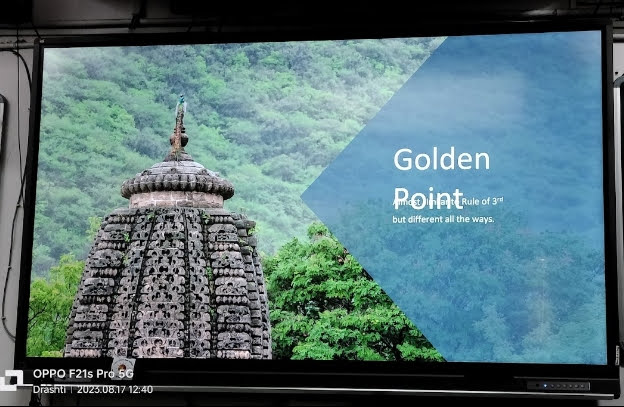
2).Golden point :-

In this type of photo there is one object which attracts viewers.


3).One third preposition :-

In this type of photography,camera focuses on three objects at one similar time.


4).Centre Focus Rule :-

Camera focuses on the centre and this photograph's central object is most important.


5).Symmetry :-

Reflection or a mirror effect is there in this type of photography.


6).Geometric shapes :-

Some geometric shapes were there in this type of photography.


7).Leading lines :- 

Some kind of unfinished lines we find in this type of photography.


8).Head/ Leading room :- 

In this type of photography, the head of the subject is very important. In short,the photograph leads viewers in the direction where the subject looks.


9).Depth of field:-

In this type of photography we find some layers. 


10).Break the rule :- 

In this type of photography, the photo does not follows any rule of the photography but though it gives a story  


After that he showed us two short films, one was on world environment day and another was on his photography. Also he introduced us to various rules of short filmmaking. After that he gave us a task to click five photographs which gave a story from the university campus. In that task , three students got ranks for their photography, among them two are from the English Department and one is from the Life Science Department. The Winners got a gift from Kaushik Ghelani sir. The name of the winners are like.,


1 . Avani Jani (first rank)


2. Dhruvi (second rank)


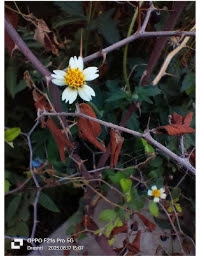
3. Drashti Joshi (third rank)


Avani jani's Photograph :-



Dhruvi's photograph:-


Drashti Joshi's Photograph :-


With the feedback of the students  we conclude our photography workshop. It was a very useful, knowledgeable and interesting workshop and in this workshop we got various new things related to photography.




Thanks for Visiting.........😊

Wednesday, 16 August 2023

Deconstuction

 Hello everyone, I am a student of the Department of English,M.K.B.U. This blog is a part of a thinking activity,and it is assigned by Dr. Dilip Barad sir. In this blog task we have to Deconstruct any literary texts, advertisement,film,poem. So ,in this blog I'm going to Deconstruct some advertisements.


What is Deconstruction ?


Deconstruction is a philosophical and literary theory that originated in the works of French philosopher Jacques Derrida. It challenges traditional ideas about language, meaning, and reality. In essence, it questions the stability and fixed meanings of texts and concepts, suggesting that they are instead characterised by a constant interplay of opposing elements. Deconstruction aims to reveal hidden assumptions and contradictions within language and texts, often leading to a more nuanced understanding of the complexity of meaning.


Derrida and Deconstruction :-


Jacques Derrida was a French philosopher known for developing the concept of deconstruction. Deconstruction is a philosophical approach that aims to uncover the complexities and contradictions within language and texts. Derrida's work challenges traditional ideas of binary oppositions, fixed meanings, and objective truths. Instead, he emphasised the fluid and evolving nature of meaning, suggesting that texts are open to multiple interpretations.


Derrida's approach involves closely examining the inherent dualities and hierarchies present in language and thought. He believed that these dualities often lead to hidden biases and assumptions. Deconstruction involves analysing texts to expose these hidden layers of meaning and to show how concepts are constructed through language. This process often destabilises the dominant interpretations and opens up new possibilities for understanding.


Derrida's ideas have influenced various fields including philosophy, literature, linguistics, and cultural studies. While his work has been both praised for its innovative insights and criticised for its perceived complexity and ambiguity, Derrida's contributions have had a lasting impact on how we approach language, meaning, and interpretation.


Derrida's contribution in to Deconstruction :-


Jacques Derrida's contribution to deconstruction is substantial and foundational. He developed the concept of deconstruction as a method of analysing texts and ideas that challenges traditional notions of language, meaning, and reality. Some key aspects of Derrida's contribution to deconstruction include:


1. Binary Oppositions :- Derrida's work focused on revealing the inherent dualities and binary oppositions that structure language and thought. He argued that these oppositions (like good/evil, presence/absence) often create hierarchies that shape our understanding. Deconstruction aims to show how these oppositions are not fixed but rather interdependent and constantly shifting.


2. Différance :- Derrida introduced the term "différance" to highlight the way language constantly defers meaning, always pointing beyond itself. He emphasised that meaning is deferred through a chain of signifiers, and this process of deferral leads to the play of differences that shapes language and thought.


3. Destabilising Meaning :- Derrida's approach seeks to unsettle and disrupt the fixed meanings often attributed to texts and concepts. He believed that texts contain contradictions, gaps, and ambiguities that reveal the complexities of language and the limits of conventional interpretations.


4. Deconstructive Reading :- Derrida's method involves a close reading of texts to identify internal contradictions, hierarchical structures, and overlooked assumptions. By exposing these elements, deconstruction aims to reveal how meaning is constructed and how interpretations are influenced by context and perspective.


5. Undecidability:- Derrida argued that because of the inherent complexities of language, there are no definitive interpretations or fixed truths. Instead, texts and concepts are marked by "undecidability," meaning that they resist a single, conclusive interpretation.


6. Contextualizing Interpretation :- Derrida emphasised the importance of considering the context and perspective from which a text is interpreted. He believed that interpretation is influenced by cultural, historical, and personal factors, and that these factors can shape different readings of a text.


Derrida's contributions to deconstruction have had a profound impact on philosophy, literature, and the humanities. His ideas have prompted new ways of approaching texts, language, and meaning, encouraging scholars to question assumptions and engage in nuanced analyses that recognize the complexities of interpretation.


Deconstruction of the advertisements :-


This advertisement is of the jewellery,but we can not get the clear idea of the product which this advertisement is trying to show. This advertisement mostly focuses on tea . So,when we watch it we are supposed to predict that this advertisement should be on the tea. But it is the jewellery.


This advertisement is of Feviquic, but it's main focus is on the sofa , straight of the sofa, a carpenter's works. This perspective highlights the way the advertisement constructs meaning around these elements while potentially downplaying the product, Feviquik, itself:


Signifiers and Signifieds :- The sofa becomes a signifier for comfort, style, and social status. The presence of a carpenter signifies craftsmanship and expertise. The strength of the sofa implies durability and reliability.


Power Dynamics of Craftsmanship :- The carpenter's role is elevated, portraying him as an authority figure. This reinforces societal hierarchies and the value placed on skilled labor, possibly perpetuating power dynamics between craftsmen and consumers.


Language and Imagery :- The ad's language might emphasize the carpenter's skills, the sofa's strength, and the attention to detail in the fixing process. These elements work together to construct an image of trustworthiness and reliability.


Consumer Desires :- The ad appeals to consumers' desire for long-lasting, sturdy furniture. By focusing on the strength of the sofa, it constructs the idea that owning such furniture aligns with an aspiration for quality living.


Product's Role :- Through deconstruction, it becomes evident that Feviquik itself is secondary in the advertisement. The product's role is subordinated to the sofa and the carpenter's expertise, suggesting that the adhesive is merely a means to achieve the desired end result.


Implicit Meaning :- The advertisement might implicitly convey the message that the strength and value of the sofa are attributed to the craftsmanship and not solely the adhesive. This interpretation could lead to the notion that the product's influence is overshadowed by the broader context.


In this deconstruction, we see how the advertisement constructs an image of quality through the sofa and the carpenter, while the product (Feviquik) takes a back seat. The advertisement potentially aligns consumer desires with craftsmanship and durability, positioning the product as a supporting element rather than the primary focus. This dynamic contributes to the construction of meanings and values in the context of furniture, craftsmanship, and durability.


************


Monday, 17 July 2023

Digital Humanities

 Hello Everyone, I am a student of the department of English,M.K.B.U. This blog is based on Digital Humanities. This blog is assigned by Dr.Dilip Barad sir.

In this blog I'm going to give some information about what is Digital Humanities and What are the project which run on the Digital Humanities.


What is Digital Humanities :-


According to chat.gpt :- Digital humanities is an interdisciplinary field that combines the methodologies and tools of the humanities with digital technology to explore research questions and produce new knowledge. It involves the application of computational methods, data analysis, and digital tools to study and analyze cultural artifacts, texts, historical records, and other forms of human expression.


Digital humanities encompasses a wide range of activities, including digitizing and preserving cultural heritage materials, developing digital archives and libraries, creating digital editions of texts, conducting data mining and visualization, employing computational analysis techniques to study literature and linguistic patterns, and using digital mapping and spatial analysis to explore historical and cultural phenomena.


The field of digital humanities emerged as technology increasingly became a part of scholarly research in the humanities disciplines. It offers new possibilities for research, collaboration, and dissemination of knowledge. Digital humanities projects often involve collaboration between scholars, librarians, archivists, and technologists to leverage digital tools and methods in innovative ways.


The application of digital humanities can lead to new insights, facilitate interdisciplinary research, and enhance public engagement with cultural heritage and scholarly work. It opens up opportunities for analyzing large datasets, exploring complex relationships between texts and ideas, visualizing patterns and trends, and making research more accessible through digital platforms and interactive interfaces.


Overall, digital humanities aims to bridge the gap between traditional humanities scholarship and digital technology, leveraging the strengths of both to advance knowledge and understanding of human culture and society.


 According to me :- Digital Humanities is a kind of  way through which people can find, explore and Store their documents, literary works with the help of digital tools and the internet. 


For Example :- Various Websites like Swayam portal,E-mail  and applications like Digiloker .


What is done under Digital Humanities. :-


Digital Humanities helps people in various ways. It also makes the work easy for people. Through the use of digital tools people can save their time and energy. With the help of Digital tools people can do research,teaching and creation of something very easily. 


"Digital Humanities" (DH) refers to an interdisciplinary field that combines traditional humanities disciplines with digital tools, methods, and technologies to conduct research, analyse data, and create new forms of scholarship. The main goal of digital humanities is to use computational methods to enhance and expand the ways in which humanistic questions are explored and answered.(chat.gpt)


Some key aspects and activities within digital humanities include:(chat.gpt)


1. Data analysis and visualisation : Using computational tools and techniques to analyse large datasets, textual materials, and cultural artefacts. This can lead to new insights and patterns that might not be immediately evident through traditional manual analysis.


2. Digital archives and collections: Creating and curating digital repositories of historical documents, cultural artefacts, and other materials to preserve and provide access to important cultural heritage.


3. Text mining and natural language processing: Employing algorithms to process, interpret, and extract information from vast amounts of textual data. This allows researchers to discover trends, connections, and meanings within texts.


4. Digital publishing and scholarly communication: Exploring new modes of publishing and disseminating research, often taking advantage of interactive media, multimedia elements, and open-access platforms.


5. Collaborative research and crowdsourcing: Engaging in collaborative projects that involve scholars, students, and the general public to contribute to research, transcription, annotation, and other tasks.


6. Cultural heritage and digital preservation: Utilising digital technologies to preserve and conserve cultural heritage, such as historical documents, artefacts, and artworks.


7. Mapping and spatial analysis: Using Geographic Information Systems (GIS) and other spatial tools to examine and present data with a geographic component, enabling scholars to analyse the relationship between space and culture.


Digital humanities has gained popularity over the past few decades, as technology has become more accessible and computing power has increased. Scholars in this field aim to bridge the gap between technology and the humanities, fostering new ways of engaging with and understanding human culture and history. Digital humanities projects often encourage interdisciplinary collaboration between researchers in the humanities, social sciences, computer science, library and information science, and other related fields.


A few Digital Humanities Projects with the links. :-


There are many projects which work for the digital Humanities.


For Example :- Digiloker, Clic Project, 'Darth' project, Rossetti Archive,Victorian Web,Ngram Viewer.


1). Digilocker :- Digilocker is an Indian government initiative that provides a cloud-based digital platform for citizens to securely store and access their essential documents and certificates. It offers a convenient and paperless way to store documents such as Aadhar cards, driving licences, educational certificates, and more, making them easily accessible anytime and anywhere through the Digilocker mobile app or website.(chat.gpt)


Here is the link of Digiloker ……  https://www.digilocker.gov.in/


2). Clic Project :- The Clic Project is a research initiative using digital tools to analyse large language datasets, uncovering insights into linguistic patterns and cultural changes over time.(chat.gpt)


Here is the link of Clic Project…https://clic.bham.ac.uk/


3). Rossetti Archive :- The Rossetti Archive is an online resource dedicated to preserving and studying the works of Dante Gabriel Rossetti, the influential poet and artist of the Pre-Raphaelite Brotherhood.(chat.gpt)


Here is the link of Rossetti Archive ….http://www.rossettiarchive.org/


4). Victorian Web :- The Victorian Web is an academic website offering articles and essays on various aspects of the Victorian era, including literature, art, history, society, and technology.(chat.gpt)


Here is the link of Victorian Web …..https://victorianweb.org/


5). Ngram Viewer :- Google's Ngram Viewer is a tool that analyses word and phrase frequencies in their digital book collection, providing visualisations to track language usage and historical trends over time.(chat.gpt)


Ngram Viewer is an online search engine that charts the frequencies of any set of search strings using a yearly count of n-grams found in sources printed between 1800 and 2019.


Here is the link of NgraViViewer.....https/books.google.com/ngrams/


Sunday, 16 July 2023

R.K.Narayan's short stories

 Hello Everyone,I am a student of the Department of English,M.K.B.U. This blog is based on R.K.Narayan's two short stories 'Crime and Punishment ' and 'An Astrologer’s Day'. 


About R.K.Narayan :-


R .K. Narayan, whose full name was Rasipuram Krishnaswami Narayanaswami, was a renowned Indian writer. He was born on October 10, 1906, in Madras, British India (now Chennai, India), and passed away on May 13, 2001, in Chennai. Narayan is widely regarded as one of India's greatest English language novelists.


Narayan's writing career spanned over six decades, during which he wrote numerous novels, short stories, and essays.However, he did write extensively in the genre of fiction, particularly novels and short stories. Some of his well-known works include:


"Swami and Friends" (1935): This novel is Narayan's debut work and introduces readers to the fictional town of Malgudi, where many of his stories are set. It explores the adventures and misadventures of a young boy named Swaminathan and his group of friends.


"The Bachelor of Arts" (1937): This novel follows the life of Chandran, a college student who faces various challenges and dilemmas as he navigates his education, love, and career.


"The English Teacher" (1945): Based partly on Narayan's own life experiences, this novel delves into the themes of love, loss, and spiritual awakening. It tells the story of a young English teacher named Krishna who struggles to cope with the death of his wife.


"The Guide" (1958): Arguably one of Narayan's most famous works, this novel tells the story of Raju, a tourist guide in Malgudi who becomes a spiritual guide for a group of followers. It explores themes of identity, morality, and the nature of success.


"Malgudi Days" (1943-1947): This collection of short stories presents a diverse range of characters and situations set in the fictional town of Malgudi. Each story offers a unique glimpse into the lives of the people who inhabit the town.


1) Crime and Punishment


About the Story :-


'Crime and Punishment' is a short story written by an Indian writer R.K.Narayan. This story is based on a teacher-student relationship. This story is all about the torturing of a teacher by the student.  


"Crime and punishment" is a thought provoking short story which keeps its suspense and twist from the beginning to the end. In this story, R K Narayan describes humorously how the surroundings, the parent's mentality and the teacher's attitude influence the personality of a child.


Question based on the story :-


The dynamic roles of teacher and student: 'Crime and Punishment' by R.K. Narayan. Give some suitable examples of movies, novels, short stories, videos, and articles related to the major themes of this story.


  • The Dynamic roles of the teacher and student.,


The teacher in the story “Crime and Punishment” by R.K. Narayan is a hardworking man. He teaches 6 hours in the school and then he comes to teach the small boy in the nursery for just 30 rupees a month. He has to work for three hours in the nursery teaching a gorilla of a child. This shows the teacher is very poor. Otherwise he would not come to teach such a mischievous imp after his normal school hours.


 The teacher suffered at the hands of the parents also. Every day he had to listen to the lectures of the parents on child psychology for half an hour. The father had written a thesis on infant psychology for his M.A. The mother had studied a good deal of it for her B.A. So, both lectured to him on the same lines. It seemed that the parents of the boy thought he was made of thin glass. They pampered him a lot and they wanted the teacher also to be very kind to the boy and not to annoy him in any way. 


The teacher found it hard to manage the boy. The boy had a lot of love and money. His parents built the nursery for him. They bought him expensive toys. They even gave him a small pedal motor to move about in the garden. His cupboard was filled with chocolates and biscuits which he could eat whenever he wanted. He was a highly pampered, spoiled child. The teacher could lose his temper when tempted too much. He slaps the boy because the boy persisted in making the same mistake in spite of the corrections so many times. The hard slapping made a red mark on the cheek of the boy. The boy used that mark to blackmail the teacher. 


His teacher had to play with the boy acting as a station master. Then the train stops running and the boy wants him to repair it. But the teacher is not at all mechanical minded and he can’t do that. Then the boy makes him tell stories. He tells the story of the tiger and the bison and the story of Ali-Baba and 40 thieves. The boy wants to hear the story of the tiger and bison again. When the teacher refuses the boy runs home, the teacher in hot pursuit.  The teacher has good presence of mind. 


When the father asks why they are running about, the teacher says they are just playing about to keep up their spirits. The teacher can lie if there is a need! Poor teacher! He has to suffer so much for getting an extra amount of Rs.30 per month! I think he represents many teachers in our society who do not get a decent salary and have to find other ways of making both ends meet.


Example of the Movie .,


Tare Zameen Par :-


Taare Zameen Par" is a critically acclaimed Indian film directed by Aamir Khan and released in 2007. The film explores the life of an 8-year-old boy named Ishaan Awasthi, played by Darsheel Safary, who struggles with dyslexia, a learning disorder that affects his ability to read and write. 


In this movie also the teacher plays a vital role. This movie is based on the teacher and student's relationship. In this movie ,the teacher (role played by Aamir Khan) is getting a very low salary as compared to other teachers because he is coming as their temporary teacher. Even when he gets a lower salary he is very faithful about his teaching or his responsibility as a teacher. So, we can compare this movie with this short story.


An Astrologer’s Day :-


About the Story :-


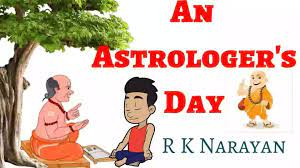
The story revolves around an astrologer who operates on a street corner in a small town in India. The astrologer, a seemingly ordinary man, uses his knowledge of astrology to make a living. One evening, a man named Guru Nayak approaches the astrologer, seeking guidance and advice. Guru Nayak reveals that he is plagued by the fear of a man he once attempted to kill and assumes he has survived.


The astrologer begins analysing Guru Nayak's horoscope and makes predictions that instil fear in him. He convinces Guru Nayak that his enemy is long dead and that he has nothing to fear. Feeling relieved, Guru Nayak thanks the astrologer and offers him money as a token of his gratitude.


After Guru Nayak leaves, the astrologer packs up his belongings and heads home. On the way, he reminisces about his dark past and how he managed to escape a life of crime. It is revealed that the astrologer is the very man Guru Nayak tried to kill years ago.


"An Astrologer's Day" delves into themes of deception, fate, and the power of belief. It showcases Narayan's ability to craft engaging narratives while offering insights into the complexities of human nature.


Questions based on the story :-


  • How faithful is the movie to the original short story?


A movie conveys the same idea as the story. In some ways the movie is different from the short story. For example., The ending scene, the story ends with a completeness but  the original story ends with incompleteness. 


  •  After watching the movie, have your perception about the short story, characters or situations changed?

After watching the movie, I have changed my perception for the situation and characters. At the first when gurunayak comes to an astrologer and chellengies him for give a correct answers at that time at first I thought that he has some doubt on an astrologers power of prediction but at the end we can get the idea that gurunayak is connected with an astrologer's past and through the gurunayak's character R.K.Narayan tries to give astrologers background information.


  • Do you feel ‘aesthetic delight’ while watching the movie? If yes, exactly when did it happen? If not, can you explain with reasons?

Yes, I feel 'an aesthetic delight' while watching the movie when astrologer gives a correct answers of gurunayak's questions. 


  • Does screening of movie help you in better understanding of the short story?

Yes, the movie helps me alot for understanding the short story because through the movie we can get or understand the thing very easily.


  •  Was there any particular scene or moment in the story that you think was perfect?

In this short story,the scene when gurunayak comes to an astrologer was perfect because this scene introduces the real background of an astrologer's life to the audience. It also represents the reason why he is working as an astrologer.


  •  If you are the director, what changes would you like to make in the remaking of the movie based on the short story “An Astrologer’s Day” by R.K.Narayan?

If  I am the director,then I will change the opening scene because there is not any kind of introduction of the character and there is not any background information about the characters. If I am the director,I will add some background information of the characters so ,the audience can get the idea of what is the reason behind gurunayak and an astrologer's fighting.